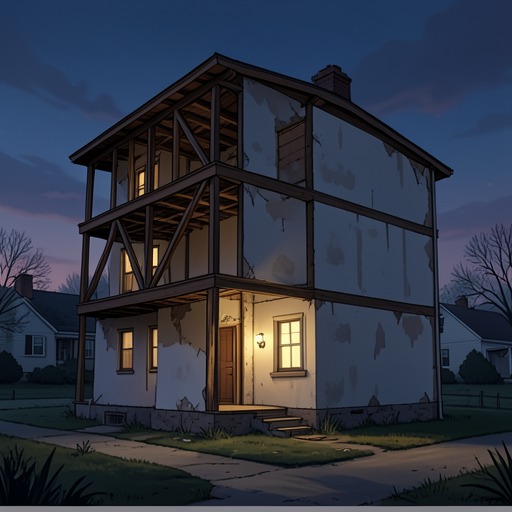
Shane’s lakeside house
Heated RivalryShane’s lakeside house is both a secluded retreat and the place where privacy fails at a decisive moment. During a two-week stay, its distance from the public gaze allows Shane Hollander and Ilya Rozanov to imagine a life less constrained by secrecy; then Shane Hollander’s father sees them wrapped around each other on the deck. The house shelters their intimacy, but cannot keep it hidden from the family whose acceptance Shane Hollander is preparing to seek.
Setting and arrival
Ilya Rozanov arrives expecting a cottage and finds a large, stone-fronted house, a property he recognizes from a television profile. The scale of the place makes the promised retreat feel suddenly real: Shane Hollander has brought him somewhere unlike anywhere he has been before, and remote enough that he believes he can let his guard down without worrying about being recognized. The house’s seclusion is therefore not just a feature of its setting. It answers a practical need created by their public lives and their concealed relationship.
The arrival also marks a contrast with the spaces where the relationship has previously been managed. In Boston, Shane Hollander had resisted moving their hookups from hotel rooms to Ilya Rozanov’s penthouse. His stated concern was being seen entering the building; beneath it lay a more personal unease about making their encounters feel less casual. Going to Ilya Rozanov’s actual home made Shane Hollander feel that his world had tilted. The lakeside house reverses that arrangement: here Shane Hollander invites Ilya Rozanov into a place that belongs to his own life, and the invitation carries the possibility of intimacy beyond their clandestine meetings.
Architecture and privacy
The interior reinforces the house’s difference from a temporary room. It is open and spacious, with high ceilings and exposed beams; floor-to-ceiling windows look toward the lake. Outside, an enormous deck extends the living space toward a pool and hot tub, with a dock and boathouse beyond. These are concrete signs of a settled home rather than a neutral place to meet and leave. When Shane Hollander tells Ilya Rozanov to make himself at home, the invitation acquires weight from the setting: this is a private world Shane Hollander is allowing him to enter.
Ilya Rozanov notices the large living room, leather sectional, expansive view, and plaid throws and pillows that strike him as conspicuously Canadian. His response moves between amused observation and genuine disorientation at the unfamiliar abundance of the place. Shane Hollander, by contrast, belongs there; Ilya Rozanov understands why he loves it. The house thus gives the two men different experiences of the same refuge: for Shane Hollander it is a familiar retreat, while for Ilya Rozanov its size and remoteness make the possibility of safety newly tangible.
A two-week retreat
The house becomes the setting for a deliberately bounded interval. As Shane Hollander drives, the two men tangle their fingers together and squeeze; for two weeks, they can pretend that their situation is not impossible. That formulation holds both the pleasure and the limit of the stay. Their private closeness is real, but the time has an endpoint and exists against the professional secrecy that continues to govern their lives.
The retreat’s privacy also differs from the cover provided by their public rivalry. Shane Hollander has kept distance from Ilya Rozanov at public events partly to avoid revealing affection through an unwitting touch, and partly because the media’s fascination with the rivals playing together makes their antagonistic image useful. At the house, the couple can step outside that public performance. Yet seclusion is only temporary protection: it gives them room to be together, not a guarantee that the truth will remain confined to them.
Discovery on the deck
That distinction becomes unavoidable when Shane Hollander’s father enters the house and sees the couple wrapped around each other on the deck. For a moment, no one moves or speaks. Then Shane Hollander’s father turns and walks toward the front door; Shane Hollander releases Ilya Rozanov and reacts with alarm. The discovery does not come through a planned disclosure or a carefully controlled explanation. It happens in the most exposed part of the retreat’s open architecture, where the house’s connection to the outdoors also leaves the couple visible to someone entering.
Shane Hollander had intended to tell his parents that he was gay, then later explain that he was in a relationship and in love, and only after that reveal the further complication. Instead, his father’s discovery reverses the order. Shane Hollander and Ilya Rozanov laugh from nerves as they recognize that the truth is emerging in the opposite sequence from the one Shane Hollander had planned. The house’s privacy has given way not through a public leak but through family proximity, bringing the concealed relationship into the immediate circle Shane Hollander most wants to address honestly.
From refuge to threshold
After the discovery, Shane Hollander goes to speak with his parents, and it is clear that his father has already told his mother what he saw. Yuna Hollander’s response shifts quickly toward practical support: she proposes working out a plan and makes clear that Shane Hollander has her on his side. That conversation takes place after the deck encounter, but the house remains its threshold—the place where an intended, gradual coming-out becomes an urgent family conversation.
The lakeside house therefore matters not simply as a beautiful or remote setting, but as the temporary home that tests what privacy can accomplish. Its size, lake-facing windows, deck, and distance from recognition make room for an intimacy that other spaces have made difficult. Its openness also enables the accidental sighting that changes the timing of Shane Hollander’s disclosure. During the retreat, the house lets the couple imagine a shared life; when Shane Hollander’s father sees them, it brings that private life into contact with family reality.